Easy Felt Cookie Ornaments: Free Patterns and Video
Soft felt layers, tiny stitched details, and a little ribbon turn simple cookie shapes into ornaments you can bring out each winter. These felt treats have the cozy look of gingerbread and iced sugar cookies, but they are light enough to hang on a tree or tie onto a gift. The project suits beginners who are comfortable cutting fabric and making a few hand stitches, as well as makers who enjoy personal holiday decorations. You will see how to use the included patterns to cut and layer the shapes, then add details with embroidery stitches and buttons or beads. It is satisfying to watch a plain piece of felt become a recognizable cookie, and each one can be finished in a short sitting. Make a small batch in matching colors or give every ornament its own icing design.

Why You’ll Love This Pattern
A firm cotton washcloth is useful at the sink, and its simple square shape makes it a good first project for practicing even rows. This beginner crochet washcloth pattern uses single crochet throughout, so you can focus on keeping the edges straight rather than managing a complicated stitch repeat.
The project takes about two to three hours and uses less than one small skein of worsted cotton. Its plain fabric is easy to wash, and the steady rhythm makes it comfortable to work on in short sessions. You can use one color or join a new color at the start of a row, though each color change adds ends to weave in.
The rows were easy to follow, and I liked having a useful square to finish in one evening. My first edge was a little uneven, but counting each row helped.
— Lena, beginner crocheter (sample review)
Pattern Overview & Skill Level
- Skill Level: Beginner. You need to make a foundation chain, single crochet, and turn your work.
- Approximate Time: Two to three hours, depending on your pace and how often you stop to count.
- Construction: A flat rectangle worked back and forth in rows, then finished by fastening off and weaving in the yarn tails.
- Finished Dimensions & Sizing: About 8 inches wide by 7.3 inches tall before washing and reshaping. Gauge is 16 single crochet stitches and 18 rows per 4 inches in single crochet.
Materials & Supplies Needed
- Yarn: About 75–90 yards of worsted-weight (#4) 100% cotton yarn. One solid color is simplest; a small amount of a second color can be used for stripes.
- Hook: 4.5 mm / US 7. Cotton fabric should feel firm but still bend easily. If your swatch is too stiff, try a 5.0 mm / H-8 hook; if it is loose and holey, try a 4.0 mm / G-6.
- Notions: Tapestry needle for weaving in ends, scissors, and a ruler or measuring tape. A stitch marker is optional for marking the first or last stitch of a row.
- Substitutions: A similar-weight cotton blend can work, but check its care label because it may stretch or dry differently. Acrylic yarn is less absorbent and may feel warmer against the skin. Changing yarn weight or hook size changes the cloth’s dimensions and texture, so make a gauge swatch first.
Stitch Guide & Abbreviations (US Terms)
- ch: Chain.
- sc: Single crochet. Insert the hook into the stitch, yarn over, pull up a loop, yarn over again, and pull through both loops.
- st: Stitch.
- sts: Stitches.
- rep: Repeat.
The turning chain at the start of each row does not count as a stitch. Work the first single crochet into the first stitch of the previous row, not into the turning chain. This keeps the sides straighter and maintains the 32-stitch count.
Step-by-Step Pattern Instructions
Washcloth
- Foundation: Ch 33. Keep the chain relaxed; a tight foundation edge can pull the bottom of the cloth inward.
- Row 1: Sc in the second ch from the hook and in each ch across. Turn. (32 sts)
- Rows 2–33: Ch 1, sc in each st across, then turn. The ch 1 does not count as a stitch. (32 sts each row)
After Row 33, compare the cloth with the target size. The expected measurement is about 8 by 7.3 inches at the stated gauge. If your piece is slightly larger or smaller, it will still work as a washcloth; the gauge is there to help you plan the finished size and yarn use.
Finishing
- After the final row, cut the yarn, leaving a tail about 6 inches long. Pull the tail through the loop on your hook to fasten off.
- Thread the tail onto a tapestry needle. Weave it through several stitches along the edge, then change direction and weave through a few more stitches so it is less likely to work loose in the wash. Repeat with the starting tail.
- Lay the cloth flat and gently smooth the edges. Do not pull the corners hard, since stretching can make the cotton fabric uneven.
Care & Washing Instructions
- For 100% cotton, wash with similar colors in warm water, up to 40°C / 104°F, unless the yarn label gives a lower limit.
- Dry flat or tumble dry on low if the yarn label allows it; reshape the cloth while it is damp.
- To block, smooth the damp cloth into a rectangle and let it air-dry flat. Follow the yarn label if you use a cotton blend or another fiber.
Pro Tips & Common Mistakes to Avoid
- Check your tension: Cotton can feel firm, but the hook should move through the stitches without strain. If your sample is smaller than 4 inches across for 16 stitches, try a larger hook; if it is wider, try a smaller one.
- Count the stitches: Count 32 stitches at the end of each row, especially for the first few rows. If you tend to lose the edge stitch, place a marker in the first stitch of each row and move it as you turn.
- Hide the tails securely: Weave each end through the fabric in one direction, then change direction. Trim close only after checking that the tail stays put when the cloth is gently stretched.
- Adjust the size carefully: To make the cloth wider, add chains to the foundation, then work one fewer single crochet than the number of chains. To make it taller, add rows. Every extra 4 inches of width or height uses roughly another 15–20 yards at this gauge, so have extra yarn available.
Frequently Asked Questions
Can I use a different yarn fiber?
Yes. Cotton is absorbent and holds its shape well for a washcloth. A cotton blend may be softer or stretchier, while acrylic is less absorbent. Use the yarn label’s care instructions and make a swatch, since a different fiber can change the cloth’s size and feel.
How can I make the washcloth larger or smaller?
For a different width, change the foundation chain and keep one fewer single crochet than the number of chains in Row 1. For a different height, work more or fewer rows. Check your stitch count and measure as you go; changing the yarn or hook also changes the finished dimensions.
Is this pattern suitable for a first crochet project?
Yes, if you can make a chain and single crochet. The main challenge is spotting the first and last stitches at the edges. Count 32 stitches after each row until the sides look even, and remember that the turning chain is not a stitch.
Can I sell washcloths made from this pattern?
Check the designer’s terms before selling finished items, and follow any credit or listing requirements. The pattern instructions themselves should not be copied or redistributed unless the designer permits it.
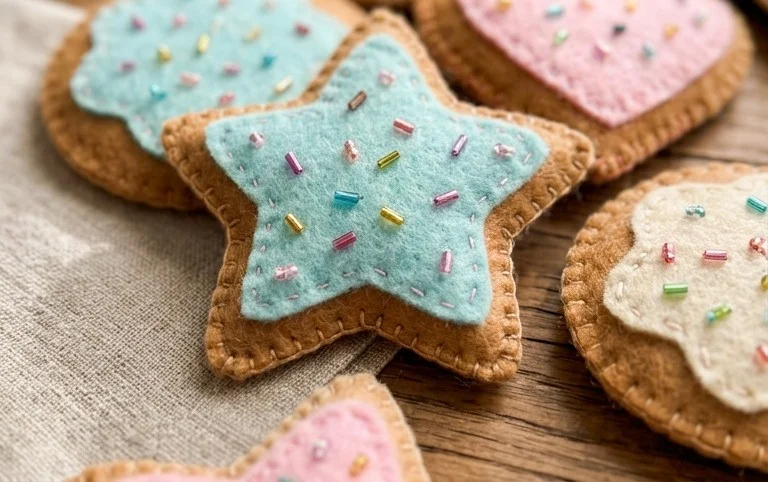
A finished felt cookie ornament brings a bit of handmade warmth to a tree, a wreath, or a wrapped present, and the stitched details make each one feel like its own little decoration. For a simple variation, change the icing thread from white to pale pink or add a tiny bead as a candy detail. You can also make the cookies smaller for gift tags, keeping the same pattern and trimming the ribbon to suit. If you make a set, share a photo on Pinterest or your favorite social media so other makers can see your colors and embellishments. Then explore more free patterns on the blog for your next handmade project.